Vision Document — v1.0
Welcome to the future
where everything works.
A compact, living retro-futuristic world where you build, own, and thrive. No waiting. No broken promises. Just a place to call home.
A compact, living retro-futuristic world where you build, own, and thrive. No waiting. No broken promises. Just a place to call home.
Not a space MMO. Not a flight simulator. A life simulation in a retro-futuristic world where space is one element, not the entire game.
Orion is positioned as a post-MMORPG — a genre that emerges after players realize "bigger = better" doesn't work. It sits at the intersection of digital ownership, cozy simulation, and a living economy.
No "content in 3 years." Minimum mechanics, maximum stability. If it isn't there, it can't break.
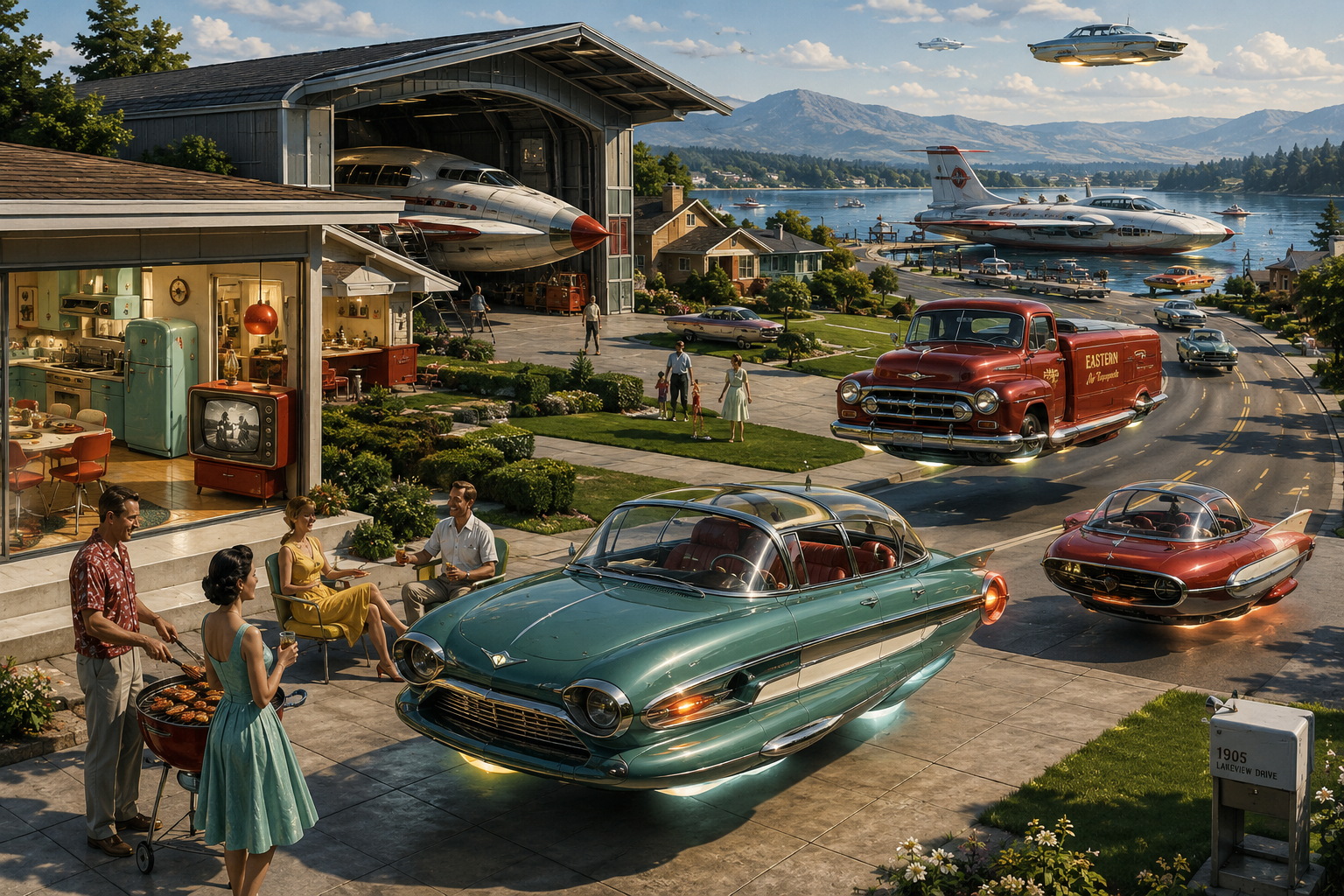
A house, a neighborhood, neighbors, transport, collections. You come to live, not to queue for a patch.
Competing on execution quality and player trust, not content quantity. Trust is the only asset that can't be faked.
"If it isn't there, it can't break." — Project mantra
| Game | What We Take |
|---|---|
| Animal Crossing | The desire to decorate and personalize space |
| Second Life | Player-created economy and social world |
| My Summer Car | Simple life simulation and ownership mechanics |
| Drive Beyond Horizons | A world built for exploration and road trips |
| Star Citizen | Sci-fi aesthetic and tech design (without the technical chaos) |
| EVE Online | Serious player-driven economy |
Retro-futurist America of the 1950s–70s. Suburban. Peaceful. No war. No survival. Just a small town where the future already arrived.
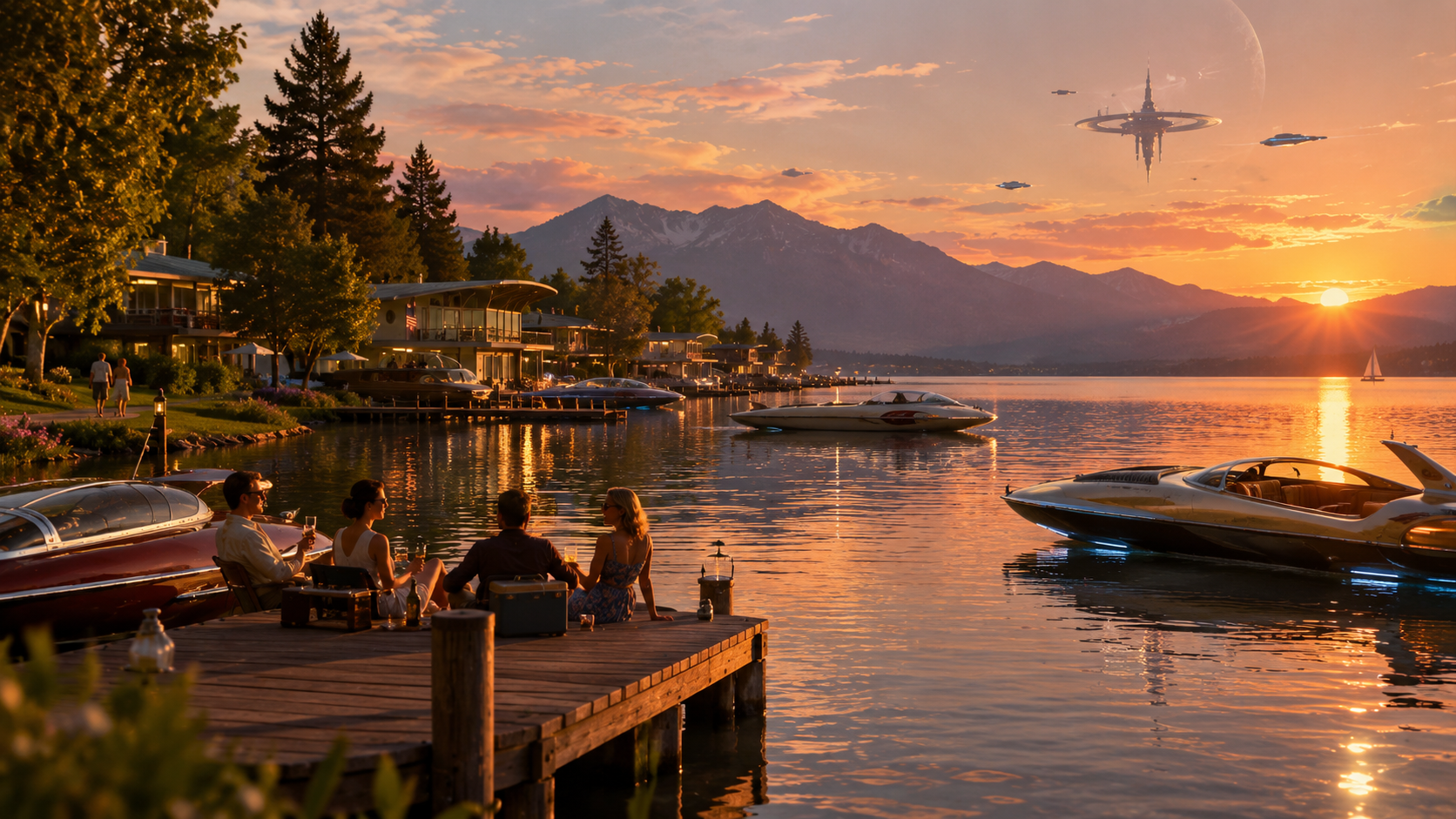
The lake district — where neighbors gather, boats float, and the orbital station is just part of the skyline.
The world is intentionally small. One city. A lake. A few islands. A moon. One planet. Not a thousand systems.
Smaller scale means: faster development, fewer bugs, denser social interaction, and a world that feels lived-in rather than empty.
Depth > Width. 50 living houses with AI neighbors and a working market beats 10,000 empty lots with no one around.
The core loop is not "kill → loot → upgrade." It's buy → build → customize → socialize → repeat.
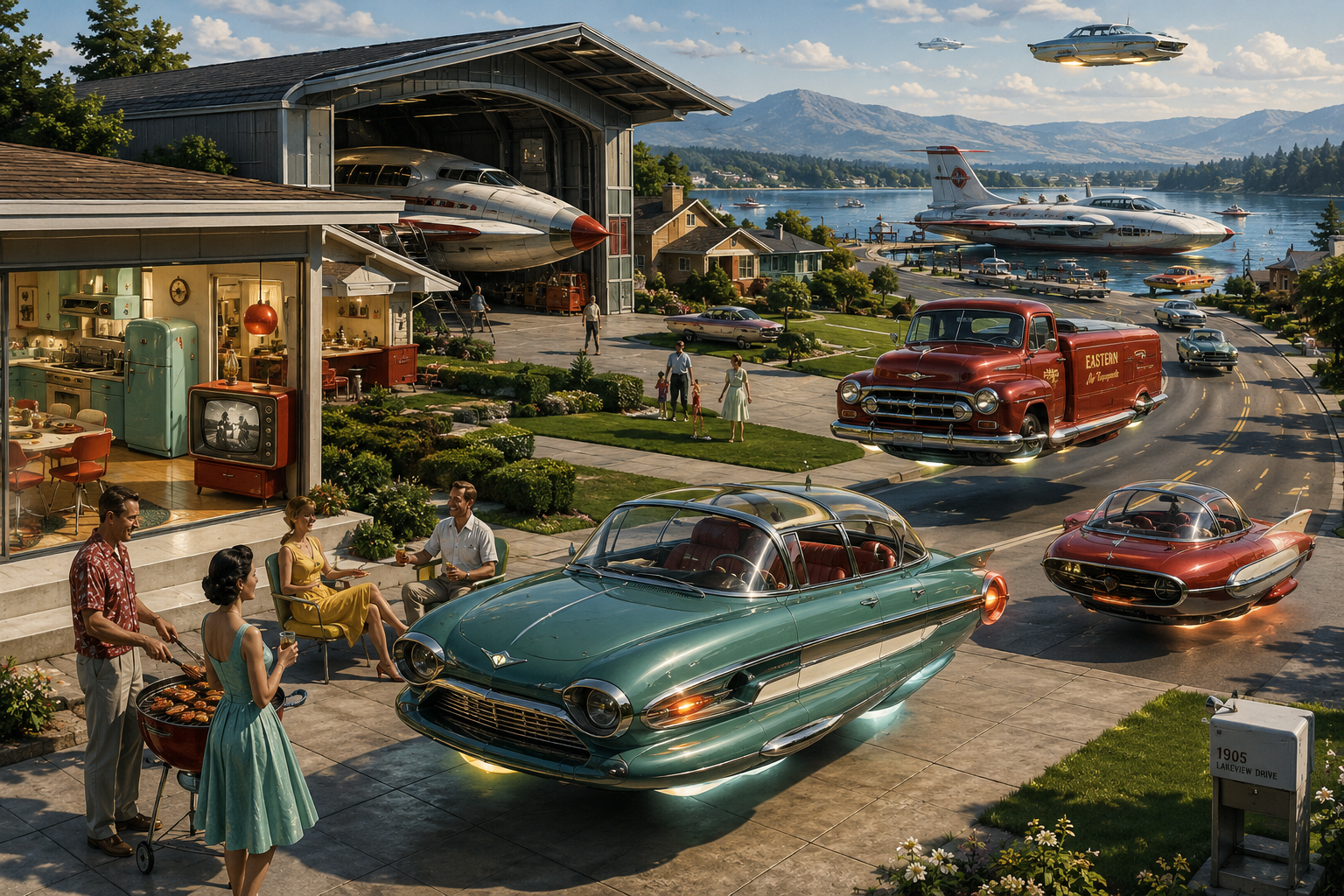
Your home is your base. The AI assistant remembers your preferences, manages your shop, and handles logistics while you sleep.
| Action | Motivation |
|---|---|
| Buy a plot | My own territory |
| Build a house | Self-expression |
| Buy transport | Convenience + collecting |
| Build a hangar | Access to new vehicles |
| Decorate | Ongoing cosmetic purchases |
| Talk to neighbors | Social attachment |
| Host events | Community belonging |
While you're offline, your world keeps living:
This transforms the game from "I must be online 8 hours" into "my world lives 24/7." The game becomes a living asset, not just entertainment.
Not "a game with an economy." A game that is an economy. This is the core product.
Players buy and sell property, vehicles, furniture, and AI characters directly. No middleman.
Market rules are a trust contract. They do not change retroactively. Ever.
Players know all risks in advance. No hidden mechanics. No surprise nerfs.
Digital assets that can be legally exchanged between players. Ownership means something.
EVE Online (economic freedom) × Animal Crossing (aesthetics of ownership) × Second Life (player-created value). Star Citizen taught us what NOT to do.
No Pay-to-Win. No power scaling. Players buy beautiful things they want to show off.
| Category | Examples |
|---|---|
| Homes & Interiors | Unique house designs, furniture sets, wall art, lighting |
| Transport | Hover cars, personal aircraft, flying boats, hover bikes |
| Skins & Cosmetics | Vehicle paint jobs, house exterior themes, character outfits |
| Hangers & Plots | Prime locations, larger hangars, lakefront properties |
| AI Characters | Custom butlers, pilots, shopkeepers, guides |
| Collector Series | Limited editions, seasonal drops, collaboration items |
SC sold ships that didn't exist for 10 years. Here: every purchased item works immediately. Buy a house — live in it day one. Buy a hover car — drive it today. No waiting.
AI operates on three levels simultaneously: as a development tool, as the world's inhabitants, and as the player's personal companion.
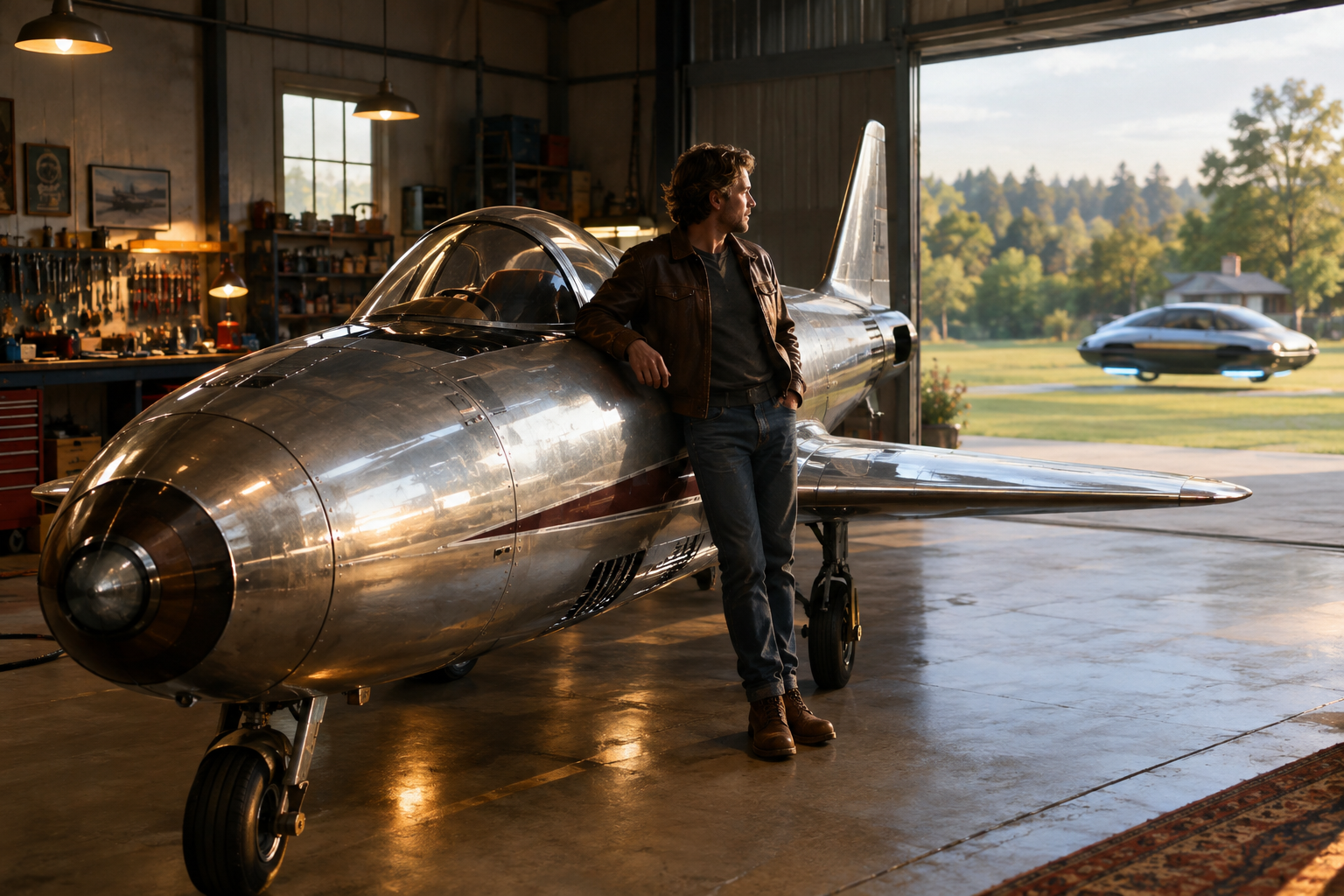
Your ship is like your car. Personal, well-maintained, loved. Not a war machine — a mode of transport.
| Level | What It Does |
|---|---|
| Development | Small team + AI = output of a large studio. Asset generation, textures, dialogue, quests, level design. |
| World (NPCs) | Living residents with memories, personalities, and economies. They buy, sell, build, and socialize. They create demand. |
| Player (Advisors) | Personal AI assistants with voice, memory, and specialization. They manage your business, advise on purchases, and remember your preferences. |
Each player gets persistent AI companions with distinct roles:
Monitors market, predicts prices, alerts on undervalued assets, manages your shop inventory.
Helps design your home, suggests furniture layouts, generates interior concepts.
Manages vehicle maintenance, production lines, resource logistics.
Social AI with personality. Remembers your stories, jokes with you, introduces you to neighbors.
NPCs are not chatbots. They are economic agents. They buy and sell. They open shops. They attend community events. They create the demand that makes the player economy feel alive.
Without them, the world is dead. With them, the town breathes.
A unique entry point into the game's economy that requires no money — only idle hardware and consent.
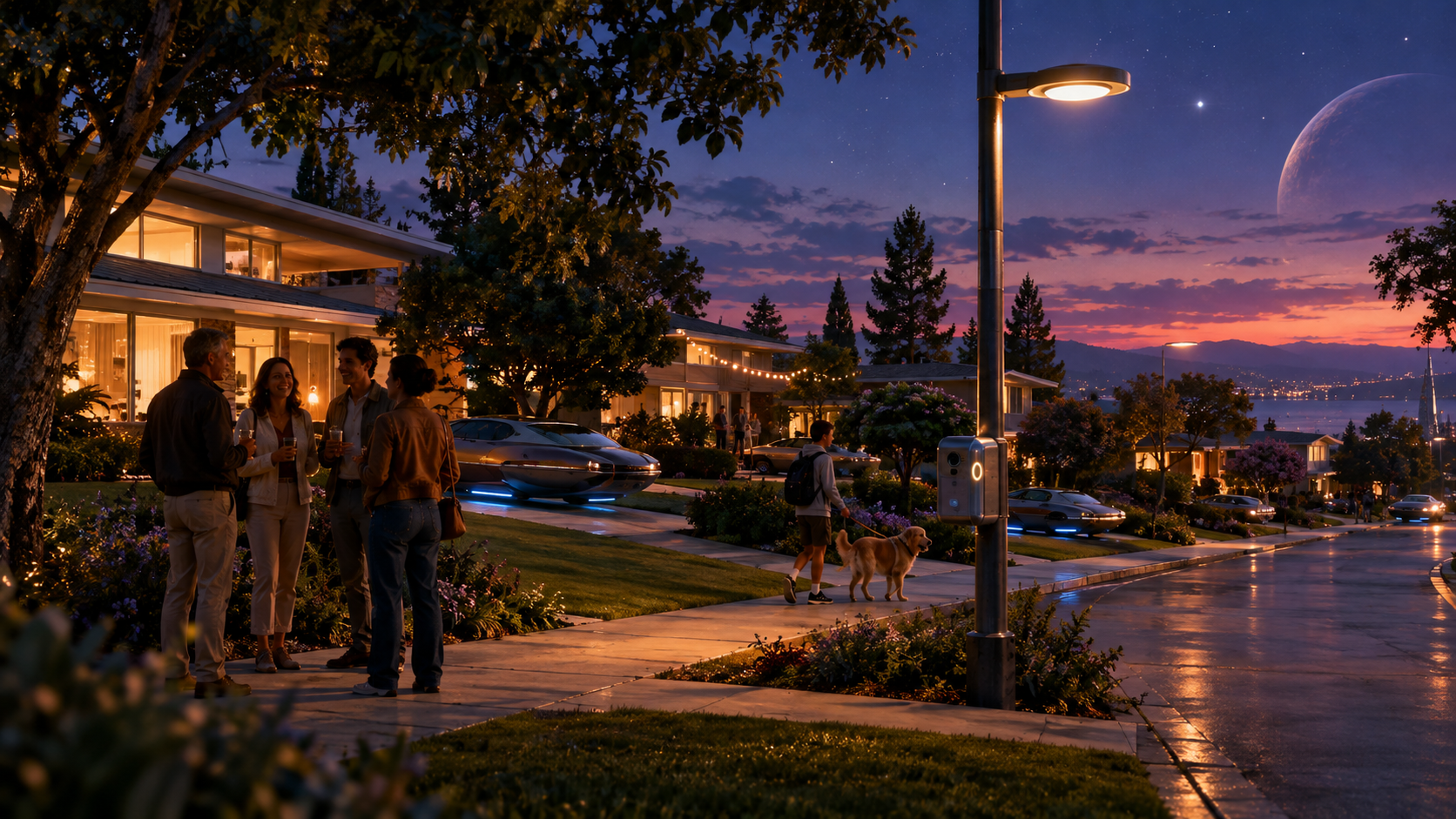
The neighborhood at dusk. The compute hub on the utility pole is just part of the infrastructure — subtle, not over-the-top.
| Mode | Description |
|---|---|
| Play Mode | Standard game launch, updates, library management |
| AI Support Mode | Voluntary computation for AI infrastructure (inference, training, simulation) |
| Community Compute | GPU/CPU contributes to project-wide AI services |
| Eco Mode | Runs only at night or when PC is idle. Minimal power draw. |
A teenager with no money can launch the client, enable Compute Mode, and participate in the economy. This is not advertising. This is not a donation. It's distributed computation with game rewards — similar to GAIMIN or BOINC, but integrated into a living game world. It also creates a structural benefit: more community compute = lower AI infrastructure costs.
Through an SDK and marketplace, players create and sell content directly to other players.
Design and sell furniture, room kits, lighting schemes.
Custom hover cars, aircraft, boats. Full 3D models with physics.
Create AI butlers, pilots, shopkeepers with unique personalities and memories.
Board games, party activities, seasonal events for the community.
A new category of digital asset: AI characters with persistent memory and behavior. Not a skin. Not a model. A character that remembers your name, your preferences, and your history.
This category does not exist in any current game. It's the next evolution of digital ownership.
Model: Roblox (SDK) + Entropia (market) + Steam Workshop (distribution) + a new AI layer.
The MVP is not a "minimal game." It's a complete small world that works perfectly.
| Feature | Why |
|---|---|
| One city | Easy to fill with life and AI |
| 20–50 player houses | Social effect from day one |
| Hover cars | Primary transport, immediate fun |
| Lake & flying boats | Peaceful recreation space |
| Hangers & small ships | Space vibe without scale |
| Item market | Economy foundation |
| Full stability | The core argument against SC |
City, houses, transport, lake, market, 20–50 players. Everything works. Nothing is broken.
Resource gathering, production, crafting, business mechanics. Players open shops, logistics companies, design studios.
Orbital station, Moon, one planet. Short flights. PvE expeditions. New districts unlock.
Full SDK, AI Marketplace, community-created content, new biomes, cross-community events.
Each phase must be fully stable before the next begins. No half-features. No "coming soon." No broken systems in production.